
Destroying the universe: How hard can it be?
In quantum field theory, the vacuum state refers to the lowest energy state in a system. Particles are excitations above this state and carry energy, hence the term “vacuum” to refer to the state with no particles.
Nothing requires this state to be unique. There may be many different field configurations that are local energy minima, and hence stable against small perturbations. A local minimum that does not globally minimize energy is called a false vacuum. While locally it looks like a stable vacuum, it is unstable and will decay to the deeper, true vacuum. If the energy barrier between the false and true vacuum is high, however, then the decay rate is exponentially suppressed and the false vacuum may be very long-lived.
Analogous behavior is common in other physical systems. Open a carbonated drink and the CO₂, more stable as a gas once the pressure is released, comes out as bubbles. But the bubbles take a moment to appear, and they form on the sides of the bottle rather than throughout the liquid. A bubble has to pay an energy cost to create its surface—the boundary between gas and liquid—and small bubbles have a larger surface-to-volume ratio. The energy gained by moving CO₂ into the gas grows with the bubble’s volume, while the cost of its surface grows only with its area; so below a critical radius the cost wins and the bubble redissolves, and above it the gain wins and the bubble grows. Reaching that critical size takes a large enough chance fluctuation, which is why the bubbles take time to appear. It is also why they form on a surface or imperfection, which supplies part of the boundary for free.
A false vacuum decays by a similar mechanism. A bubble of the true vacuum forms through quantum or thermal fluctuations. If the bubble is large enough, the gains from the bubble’s volume outweigh the energy costs of the bubble wall and so the bubble will expand. The energy released would be enormous, accelerating the wall to nearly the speed of light. It cannot be outrun, and it gives almost no warning, since the wall travels nearly as fast as the gamma radiation that would announce it. Everything it reaches is destroyed.
Within the bubble, the local laws of physics will be radically altered. And in case you were hoping to somehow cheat death and survive the crossing, or at the very least for complex behavior to continue in the baby universe after our demise, Coleman & De Luccia (1980) showed gravitational collapse into a singularity is the more likely outcome:
Vacuum decay is the ultimate ecological catastrophe; in the new vacuum there are new constants of nature; after vacuum decay, not only is life as we know it impossible, so is chemistry as we know it. However, one could always draw stoic comfort from the possibility that perhaps in the course of time the new vacuum would sustain, if not life as we know it, at least some structures capable of knowing joy. This possibility has now been eliminated.
Seems bad.
I think we very likely live in a false vacuum—around 90%—but that deliberately triggering its decay is probably impossible, even for a galactic-scale civilization. I put the chance it could be done at around 25%, combining a 10% chance through Higgs metastability with a 16% chance through instabilities in quantum gravity. In the near term, with the resources of Earth or the solar system, it looks very unlikely. If we do live in a false vacuum and its decay can be deliberately triggered, this suggests a fully laissez-faire approach to space colonization is inadvisable, as any sufficiently advanced civilization could unilaterally destroy most of the value in our future light cone.
The Standard Model predicts a metastable vacuum
The Standard Model is our best theory of particle physics, describing all known non-gravitational phenomena. Under certain parameter ranges, it predicts that we live in a false vacuum, as the Higgs potential becomes negative at high energies.
Current experimental measurements place us very close to the boundary between absolute stability and metastability. Our best estimates suggest the universe is only metastable, but uncertainties are large enough that we cannot yet rule out absolute stability with high confidence, with the top quark mass driving most of the uncertainty; see Hiller et al. (2024) for further discussion. Under differing assumptions stability is disfavored anywhere from just 0.7 \(\sigma\) to about \(4\sigma\); overall I think there’s a roughly 90% chance that true parameters imply metastability.
At central parameter estimates, the Higgs potential first turns negative around \(10^{10}\) GeV and remains negative up to the Planck scale. These energies are much greater than anything that we can directly access through experiments—collision energies at the LHC, for example, are \(10^4\) GeV—but much lower than the Planck scale of \(10^{19}\) GeV where gravitational effects become important. Should we expect the Standard Model to remain valid at these scales?
The lack of hard experimental data makes this question impossible to definitively answer, but I think the extrapolation is probably valid. Neutrino masses suggest new physics at \(10^{15}\) GeV, but otherwise all the indirect probes we have are null and compatible with no new physics up to high energies. 1 On theoretical grounds, intermediate-scale extensions are generally unnatural, requiring an additional mass scale to be added to the model by hand. 2 This last argument is qualitative—ultimately we do not know the prior over high-energy theories, which is a question about quantum gravity—but I think it is a real reason to expect a desert, not just an absence of evidence. Putting this together, I’d give the extrapolation about an 80% chance of holding, including both scenarios where the Standard Model remains exactly correct and ones where it is modified but these modifications do not stabilize the vacuum. Combined with experimental uncertainty this gives an overall estimate of 70% that the Higgs potential is metastable.
While the Higgs potential is probably not stable, the lifetime of our universe is nevertheless very long. In Andreassen, Frost & Schwartz (2018) the lifetime is estimated at \(10^{139}\) years, with a 95% confidence that it is above \(10^{58}\) years given current top mass and other electroweak parameter estimates. By contrast, the universe itself is only about \(10^{10}\) years old.
Deliberately triggering electroweak vacuum decay is probably not possible
To trigger false vacuum decay requires creating a “bubble” where the Higgs value in the interior is greater than the boundary height of \(h_0\sim 10^{10}\) GeV. This bubble has to be big enough that the volume wins over surface area, which requires a radius
\[r_0 \gtrsim\frac1{h_0\sqrt{|\lambda|}}\,,\]where \(\lambda \sim 0.01\) is the quartic coupling. The minimum energy required is
\[E \sim \frac{4\pi h_0}{\sqrt{|\lambda|}}\,.\]Since a given Higgs quantum trapped in a region of size \(r_0\) has energy \(\sim r_0^{-1}\), the total quanta required for this configuration is
\[N\sim Er_0 \sim \frac{4\pi}{|\lambda|}\,.\]Putting this all together, triggering false vacuum decay requires creating a coherent state of \(\sim1000\) Higgs bosons within a region of radius \(\sim10^{-25}\) m. The total energy requirement is less than a kilojoule.
Despite the pedestrian energy cost, even granting arbitrarily powerful futuristic technology there appears to be no way to reliably engineer this configuration. Our ability to create and manipulate the Higgs field is limited by the interactions allowed by the Standard Model, and it simply doesn’t give us the right tools.
Consider, first, whether a static lump of matter could catalyze decay. The issue is that, because every Standard Model particle gets its mass from the Higgs, raising \(h\) makes matter heavier and more energetically costly, stabilizing the vacuum. In any case, a matter density of \(\sim 10^{40}\) GeV \(^4\) would be required to plausibly shift the Higgs field by \(\sim10^{10}\) GeV; by contrast, ordinary matter has a density of \(10^{-17}\) GeV \(^4\) and even neutron star cores only reach \(10^{-2}\) GeV \(^{4}\).
The paper Strumia (2023) discusses and rules out several more approaches. Colliding a small number of particles together cannot work, because the amplitude to create \(O(1000)\) Higgs bosons remains exponentially suppressed. But colliding many particles together in order to create a thermal fireball also doesn’t work, because the thermal decay rate remains exponentially suppressed at every temperature (and indeed, it is usually assumed, though without any direct evidence, that temperatures \(\gg 10^{10}\) GeV were achieved in the early universe).
Coherent collisions
If generic collisions don’t work, could a carefully engineered \(\gg N\) collision work? The issue is that the coherent \(N\) -body Higgs state required to trigger collapse appears basically impossible to engineer, at least without creating too much thermal background.
Let’s start with the task of creating a single \(10^9\) GeV Higgs boson in a specified state. The Higgs boson is neutral and has a lifetime of \(10^{-22}\) s, so the only realistic option is resonant on-shell production by collision of more stable particles. Strumia (2023) suggests using a muon-antimuon pair:
\[\mu^-+\mu^+ \rightarrow h\,,\]though in principle one could consider electron-positron or photon-photon collisions. 3 Conservation of momentum means that the Higgs boson trajectory can be controlled by modifying the muon and antimuon beams.
A \(10^9\) GeV muon beam would be highly futuristic—around \(10^5\) more energetic than the LHC—but there seems to be no in-principle barrier to achieving this with a \(\sim10^7\) km linear accelerator, about 25 times the distance between the Earth and Moon. Getting substantial Higgs production is much harder. Even with quantum-limited luminosity and perfect resonance tuning, the useful Higgs yield per effective muon-antimuon encounter is only
\[p_{\text{prod}}\sim\Gamma(h\rightarrow \mu\mu)/m_h \sim 10^{-8}\,.\]Thus producing \(N\sim10^3\) Higgs bosons already requires order \(10^{11}\) effective resonant source events, before accounting for any penalty from putting the Higgses in the desired state. Achieving even this idealized luminosity seems far beyond any ordinary extrapolation of accelerator technology.
But the biggest challenge is that we need to produce the Higgs boson in a very specific state: the inward \(s\) -wave configuration that, as Strumia (2023) shows, can cause collapse. In this configuration, the Higgs is spread spatially over a spherical shell, with each piece of the shell moving inward. By contrast, ordinary muon-antimuon collisions create localized Higgs bosons with definite momenta. Such local encounters can produce Higgs bosons moving toward the center, but each has very low overlap with the global inward \(s\) -wave. Trying to brute-force this by engineering \(\gg 10^{11}\) independent local collisions would create an enormous background of failed muons and other Standard Model debris, likely destroying the clean Higgs configuration one was trying to prepare.
The background problem could be avoided if the muon and antimuon themselves arrived in a suitable \(s\) -wave-like quantum state: delocalized over the relevant spherical shell, phase-matched to the desired Higgs wave, and correlated so that if the muon component occupies a given patch of the shell, the antimuon component occupies the matching patch with the right momentum and phase. In effect, the parent \(\mu^++\mu^-\) state would have to be the time reverse of the desired Higgs wavepacket. Even preparing a single such entangled, ultra-relativistic muon-antimuon pair appears completely fantastical; false vacuum decay would require roughly \(10^{11}\) such effective pair excitations simultaneously.
Tiny black holes
The final route discussed in the literature is black hole catalysis. This topic is controversial, with some authors arguing that tiny black holes strongly destabilize the vacuum (e.g., Burda et al. (2015); Gregory (2024) reviews the case) while others argue that an exponential suppression survives (Strumia (2022); Shkerin & Sibiryakov (2021); Geller & Telem (2026)). While I am not expert enough to assess these arguments in detail, the ‘decay remains exponentially suppressed’ view looks overall much more plausible to me and I would assign an 80% credence.
If micro black holes did catalyze Higgs decay, could an advanced civilization create them? A black hole forms once enough energy is packed inside its Schwarzschild radius \(R=2GM\), and—unlike the Higgs bubble—gravity collapses any such energy, whatever its quantum state. So the cleanest route is to collide two particles at \(\sqrt s\gg M_{\text{Pl}}\sim10^{19}\) GeV and let them collapse on contact.
I’m not sure whether even a highly advanced civilization could engineer such a collision. Accelerating a muon to the Planck energy using existing methods would require a linac about \(10^{17}\) km long, which is somewhat smaller than the radius of the Milky Way galaxy. Smaller accelerators using stronger electric fields are in principle possible, up to the Schwinger limit of
\[\frac{m_e^2c^3}{e\hbar} = 1.3\times10^{18}\text{ V/m}\,,\]above which electric fields become unstable to pair production. If such fields could be engineered, the minimum linac length could be reduced to just \(10^7\) km, though it is very unclear whether any realistic method could approach this.
The collision cross-section would be on the order of the Planck area, \(\sigma\sim\pi R^2\sim10^{-69}\) m², and so collisions are very rare unless the beam is extremely dense and well-aimed. The luminosities proposed for near-future colliders are \(L\sim10^{39}\) m \(^{-2}\) s \(^{-1}\), and at these rates it would take \(10^{22}\) years to produce a single collision. A galactic-scale civilization could run many experiments in parallel, but even with the entire stellar output of a galaxy a collision would occur every \(10^5\) years. With advanced engineering it might be possible to substantially increase luminosity and therefore decrease the energy requirements, but nevertheless Planckian collisions seem to require galactic scale engineering.
Even granted that tiny black holes can catalyze vacuum decay, it is not clear that these Planckian collisions generate black holes, as at these collision energies, quantum gravitational effects are strong. Substantially trans-Planckian collisions should create suitable black holes, and would also have a higher cross-section, thus reducing luminosity requirements, but would need commensurately larger accelerators.
Rather than colliding two trans-Planckian black holes, the alternative is to collide many sub-Planckian particles together simultaneously. By the Hoop conjecture, packing an energy \(E\) within its Schwarzschild radius
\[R = \frac{2GE}{c^4}\]will produce a black hole of mass \(E/c^2\). Instead of colliding two Planckian particles, you could instead collide \(N\) fermions, each with energy \(E\), into an area of radius
\[R = 3\times10^{-29}\text{ m}\times\left(\frac{E}{10^{15}\text{ GeV}}\right)\times\left(\frac{N}{10^{10}}\right)\]While using many particles allows the energy requirements per particle to be lower, engineering a precise enough collision between such larger numbers of particles looks very infeasible.
Summary
Triggering false vacuum decay looks hard. Conditional on a metastable Higgs potential:
- I assign a 10% chance that an advanced civilization could trigger decay by creating the required coherent-Higgs state.
- I assign a 20% chance that small black holes catalyze false vacuum decay and, conditional on that, a 30% chance that an advanced civilization could create the required black holes. In the previous section I gave 70% credence that the Higgs potential is metastable, and so combined with the above estimates we find overall there is a \(\sim10\%\) chance that an advanced civilization could intentionally destroy the universe through Higgs metastability.
Closer analysis of the Higgs coherent-state engineering or many-particle-implosion route to black hole creation could sharpen our sense of their feasibility; the physics is, in principle, well-understood. The issue of black hole catalysis, too, should be resolvable by theory. Better measurements of the top-quark mass could confirm whether the Standard Model is metastable. But that will probably have to wait until at least HL-LHC data starts to be published in the early 2030s, or possibly a future electron-positron collider with cleaner backgrounds.
Whether the Standard Model can be extrapolated up to \(10^{10}\) GeV is the least resolvable issue. We might discover new physics which modifies the Higgs stability but I think this is very unlikely in the near-term. A full understanding of 2-body Planck-scale collisions will likewise stay out of reach for the foreseeable future.
Vacuum decay beyond the Standard Model
It is hard to say much with confidence about physics beyond the Standard Model. At extremely high energies the Standard Model must give way to a theory of quantum gravity, but such effects likely only become important at the Planck scale, \(10^{19}\) GeV, far beyond anything that is experimentally accessible in the near-term. Our only option, then, is to consider theoretical arguments and indirect experimental evidence.
String theory, as far as anyone understands it, predicts a vast landscape of vacua that are generically metastable (see, e.g., Cicoli et al. (2023), for a recent review). If string theory is correct, our own universe is almost certainly metastable. Even if string theory is not correct, I think the more general picture of a quantum gravitational theory with numerous vacua seems likely. The existence of multiple metastable states is not uncommon even in mundane physical systems like water or cocoa butter, so it seems a priori plausible that quantum gravity is at least as rich. Indeed the Standard Model itself, when coupled to gravity, appears to permit many lower-dimensional solutions (Arkani-Hamed et al. (2007)) in the semiclassical regime where such calculations should be reliable.
Indirect observational evidence comes from the fine-tuning of the cosmological constant, for which anthropic selection from a much larger multiverse is the only plausible explanation that has been proposed (Weinberg (1987)). I suspect similar anthropic selection underlies the smallness of the Higgs mass (Agrawal et al. (1997)), although this is more controversial (see Craig (2023) for a recent review). The flatness and horizon problems also suggest our universe previously existed in a distinct, inflationary phase, consistent with there being multiple metastable states for the universe to occupy.
Taken together, all of this suggests there are probably multiple vacua. If so, it seems unlikely that ours is the one true, lowest-energy vacuum. I’d put the chance that our universe is metastable in this way at around 80%, independent of the Higgs instability discussed earlier, and would guess this is roughly in line with the expectation of most but by no means all theoretical physicists. It is, of course, hard to have much confidence here. Prospects for resolving it in the near term, whether by decisive theoretical arguments, experiments, or new observations, are in my view very dim. 4
Given how little we understand quantum gravity, it is hard to say what triggering such a decay would even look like. It would presumably require physics at extremely high energies—perhaps the Planck-scale scattering discussed earlier, of the kind that would form micro black holes. But even that, I would guess, is generically not enough: as with Higgs vacuum decay, few-particle scattering doesn’t create the kinds of coherent states required, and to my knowledge no one has studied this in detail. If forced to guess, I’d put the chance that such a decay could be deliberately induced by an advanced civilization, conditional on the universe being metastable in this way, at 20%, for an overall 16% probability unconditionally for this channel.
Empirical bounds on triggering false vacuum decay
The universe hasn’t ended yet, which means that ordinary astrophysical processes have extremely low probability of causing false vacuum decay. This provides strong empirical constraints on triggering false vacuum decay through current or near-future technology, but ultimately it doesn’t tell us much about the capabilities of a galactic civilization.
Cosmic rays—high-energy protons and light nuclei of poorly understood origin—provide the most direct evidence. The Oh-My-God particle is the most energetic particle ever detected, with an energy of about \(3\times10^{11}\) GeV (Bird et al. (1995)). In a direct collision with a stationary proton the center-of-mass energy would be about \(7\times10^{5}\) GeV, roughly 50 times higher than the LHC. Since numerous such collisions have taken place throughout the Earth’s history, we can be confident that the next few generations of particle collider are of no danger to us (Jaffe et al. (2000); Taylor (2008)).
A naive estimate suggests that the highest-energy 2-body cosmic-ray collision in our past light cone occurred at energies of around \(10^{11}\) GeV, which is already close to the Higgs instability scale (Hut & Rees (1983)). Strumia (2023) argues that, because cosmic rays are concentrated in compact astrophysical accelerators, the number of such collisions near the instability scale may run as high as ~ \(10^{70}\), far above the naive estimate. This could suggest maximum cosmic-ray collision energies of perhaps \(10^{13}\) GeV or higher.
Three-body collisions at higher energies are very rare, and many-body collisions have never occurred. The cosmic-ray bounds give us very little information about multi-body collisions, and as we’ve already discussed, the Higgs instability probably would require a very large number of particles to be collided. So we can conclude that just creating a massive accelerator and accelerating things to \(10^{11}\) or even \(10^{13}\) GeV is not enough to destroy the universe, but configurations engineered to give multi-particle collisions are totally unconstrained. Two-body Planckian scattering, of the sort that maybe could create tiny black holes, is also unconstrained.
Other lines of evidence are, unfortunately, very weak. We know the early universe was extremely hot, for example, and Big Bang nucleosynthesis provides compelling evidence for temperatures as high as a few MeV. Physicists generally assume that the universe passed through much higher temperatures. Inflationary models could have reheated the universe as high as \(10^{16}\) GeV, and thermal leptogenesis—the most plausible candidate for baryogenesis—requires temperatures \(\gtrsim10^9\) GeV. However, we have no direct evidence for this period and so cannot confidently rule out triggering false vacuum decay through extreme temperatures.
Detecting even a sufficiently small primordial black hole would let us rule out black-hole catalysis. A hole light enough to be evaporating shrinks through the low-mass regime where catalysis would be strongest, so had any formed, and had catalysis worked, the universe would already have decayed. Their decay signatures would be reasonably visible, but none has been confirmed (Carr et al. (2026)), and it seems unlikely future searches will turn up such a population. Since we have no particular reason to think primordial black holes formed at all, this tells us little either way.
Appendix: A simple model for false vacuum decay on cosmological scales
If a galactic civilization could trigger false vacuum decay, it would destroy most—but not all—of the value in our future light cone.
We colonize outward from our galaxy at the speed of light. Each colonized galaxy triggers decay with some probability, and the resulting bubble spreads at the speed of light, destroying its future light cone. The universe is expanding, so light reaches only a finite comoving distance, the cosmological event horizon. We set this distance to 1.
First take colonization at the speed of light, with each galaxy triggering as soon as it is settled. A bubble that starts at \(x\) runs until the horizon, so it reaches comoving distance \(1-\lvert x\rvert\). A galaxy at \(y\) is destroyed when a trigger lies close enough to reach it,
\[|x-y| \le 1 - |x|.\]These points \(x\) form an ellipsoid with foci at the origin and at \(y\), of volume
\[V(y) = \frac{\pi}{6}\left(1 - |y|^2\right).\]Triggers are a Poisson process. With \(N\) the expected number inside the horizon, of volume \(\frac{4}{3}\pi\), the expected number inside the ellipsoid is
\[\mu(y) = N\,\frac{V(y)}{\frac{4}{3}\pi} = \frac{N}{8}\left(1 - |y|^2\right),\]and the galaxy survives with probability \(e^{-\mu(y)}\). We track \(f(N)\), the fraction of colonized galaxies that survive. With colonization at the speed of light every galaxy inside the horizon is eventually settled, so the average runs over the whole ball; with \(s = \lvert y\rvert\),
\[f(N) = 3\int_0^1 s^2\, e^{-\frac{N}{8}(1 - s^2)}\,ds.\]At large \(N\) the integral is set by \(s\) near 1, giving
\[f(N) \to \frac{12}{N}.\]Survival depends only on \(N\), and falls as \(1/N\) rather than exponentially. The survivors are the galaxies at the frontier: a bubble launched behind them moves at the same speed and never catches up.
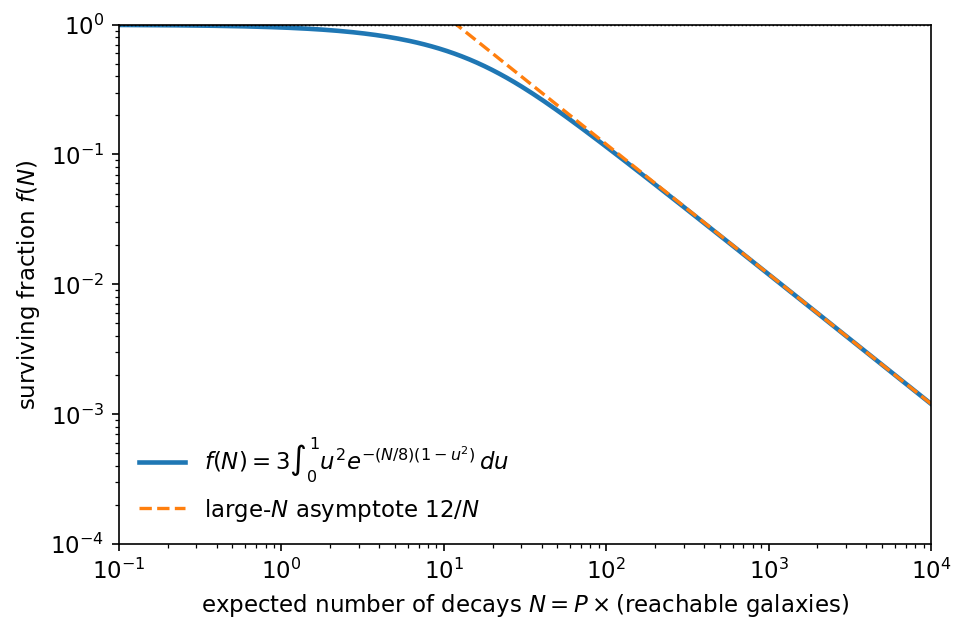
Now let colonization run at \(\beta c\) with \(\beta < 1\), and let each galaxy take a proper time \(t\) to trigger. A bubble that fires later has less of the finite future left to expand into. In a de Sitter universe with Hubble time \(t_H\), the delay shrinks its reach by a factor
\[\delta = e^{-t/t_H}.\]A trigger at \(x\) now reaches comoving distance \(\delta\left(1 - \lvert x\rvert /\beta\right)\), so \(y\) is destroyed when
\[\frac{|x|}{\beta} + \frac{|x-y|}{\delta} \le 1.\]Now only galaxies we actually reach count, so \(f(N)\) averages over the colonized ball \(s \le \beta\),
\[f(N) = \frac{3}{\beta^3}\int_0^\beta s^2\, e^{-\mu(s)}\,ds.\]A galaxy at radius \(s\) can be destroyed only if some trigger reaches it; minimizing the left-hand side above along the line from the origin to the galaxy gives \(s/\max(\beta,\delta)\), so the galaxy is exposed only when \(s \le \max(\beta,\delta)\). Which regime we are in is set by the outermost colonized galaxy, at \(s = \beta\).
If \(\beta > \delta\), colonization outruns the bubbles. Their reach \(\max(\beta,\delta) = \beta\) is exactly the colonization radius, so the frontier galaxies sit at the very edge of what any bubble can touch, where \(\mu \to 0\), and survive. A near-frontier galaxy is exposed only to triggers in a small region beside it, of volume \(\propto (\beta - s)^3\), so survival falls as a soft power law,
\[f(N) \sim \frac{\Gamma(1/3)\,(\beta^2 - \delta^2)^{2/3}}{\beta^{4/3}\,\delta}\,N^{-1/3}.\]If instead \(\delta > \beta\), the bubbles outrun colonization. Their reach extends past the colonization radius, so every colonized galaxy—the frontier one included—lies strictly inside reach of some trigger, with \(\mu\) bounded away from zero. Survival then falls exponentially,
\[f(N) \sim \frac{12}{N}\,e^{-(\delta - \beta)N/8},\]the rate being the exposure of that marginal frontier galaxy (this is the leading form for \(\beta,\delta\) near 1, the relevant near-light-speed regime). The frontier is caught, and almost nothing we colonized survives.
The Hubble time \(t_H\approx 1.5\times10^{10}\) years. Timescales for galactic engineering are unclear but given galaxies themselves are \(\sim10^5\) light-years across, we might expect false-vacuum decay, if relatively easy to trigger, could be induced within \(10^6\) – \(10^7\) years. If so, outrunning false vacuum decay would require expansion to occur at a rate
\[\beta \gtrsim 0.9999\,.\]-
In particular, the absence of proton decay rules out baryon-number-violating physics up to \(10^{16}\) GeV while various flavor-symmetry violations are ruled out at up to \(10^{6}\) – \(10^7\) GeV. Cosmology and astrophysics also provides non-trivial constraints on new physics. ↩
-
Naturalness refers to the idea that parameters in a model should generically have values determined by the length-scales of the underlying phenomenon. In this case, all length-scales in physics are expected to ultimately derive from Planck-scale physics, and therefore all dimensionful parameters are generically also Planck-scale. I should emphasize this expectation is not an aesthetic preference but instead one derived from generic Bayesian reasoning over theory space: low-energy parameters are complicated mixtures of high-energy ones, so getting out a scale far below the Planck scale is unlikely. Analogous reasoning is routinely used in condensed-matter physics and fluid dynamics to correctly predict low-energy behavior in such systems. The natural expectation is therefore a desert: no new mass scales between the electroweak scale and the Planck scale.
Low scales can be generated naturally, but only through specific and limited mechanisms such as dimensional transmutation or a seesaw. The deeper obstacle is that the Standard Model is rigid: there are very few ways to couple new physics to it at all. Coupling through the Higgs requires a new mass scale put in by hand; coupling through a new gauge force means building a whole chiral gauge sector with its own anomaly-free fermions, and even the simplest such models are baroque.
While I think the above reasoning is correct, I should note that applications of naturalness are controversial. The Higgs mass itself is, famously, not natural, and pre-LHC model-building was often motivated to “solve” this problem. But unlike other applications of naturalness, the Higgs mass is strongly confounded by anthropics, and I think the obvious takeaway is that the Higgs mass is simply unnatural due to anthropic selection. ↩
-
The tau couples more strongly to the Higgs but is probably too unstable to work with. Free quarks are, of course, not available and the relevant hadron-antihadron cross-section is extremely low due to their composite nature. ↩
-
This is, for obvious reasons, not a popular view among those still working on fundamental physics! But in my experience it is common among formal high energy theorists, who have generally given up on any experimental evidence providing useful information about quantum gravity; and it is probably even more common among those that have quit physics entirely. ↩